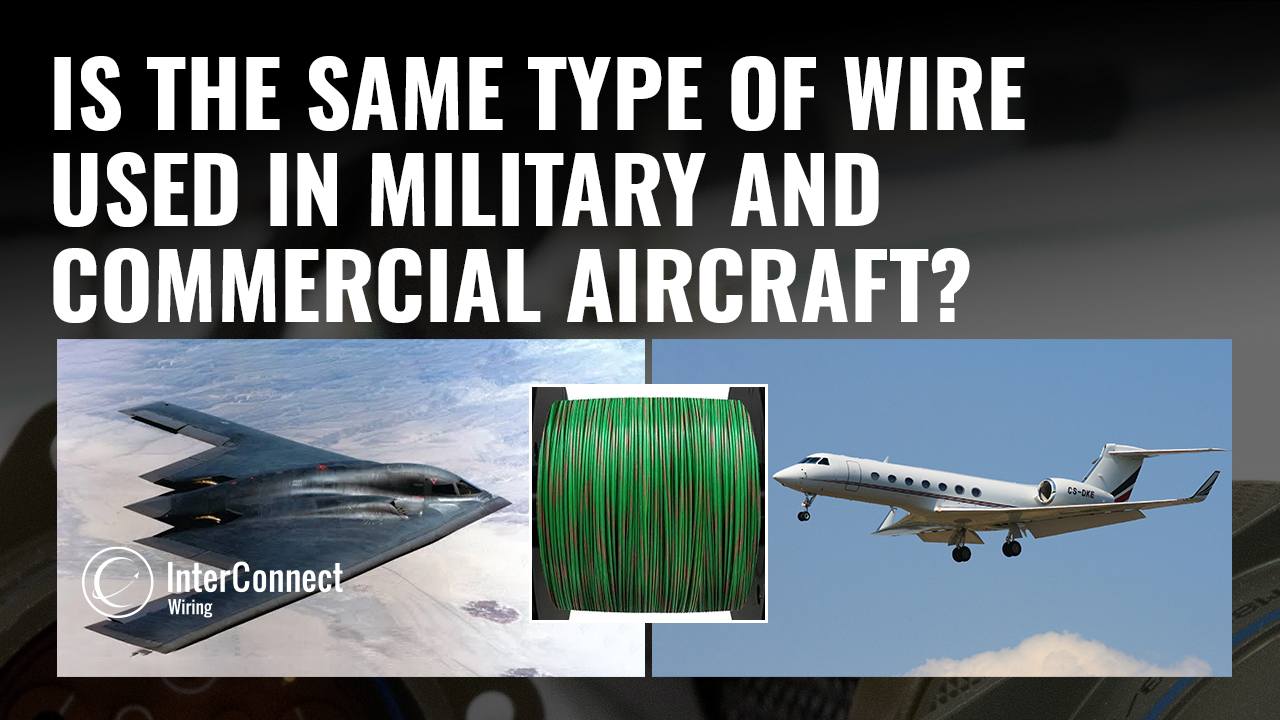
The short answer is yes. Military and commercial aircraft can use some of the same types of wire. However, that does not mean aircraft wire is universally interchangeable.
The correct wire depends on the aircraft’s design, electrical load, operating environment, and approved engineering data. Even if two wires appear identical, differences in their materials or performance ratings may make them suitable for completely different applications.
Here at InterConnect Wiring, we specialize in manufacturing electrical products for aerospace and defense. Every wire and component we use must meet the exact requirements established for that particular aircraft and program.
What Types of Wire Are Used in Aircraft?
Both military and commercial aircraft may use copper or copper-alloy conductors with high-performance insulation. Depending on the application, an aircraft’s Electrical Wiring Interconnection System (EWIS) may also contain:
- Shielded wire
- Coaxial cable
- Fiber-optic cable
- Power feeder cable
- Twisted wire pairs
- Specialized high-temperature wire
These wire types help transmit electrical power, data, and signals throughout the aircraft.
The same general wire construction may appear in both commercial and military aircraft. What matters is whether the specific wire meets the engineering requirements for its intended use.
What Determines Whether a Wire Can Be Used?
Engineers must consider several factors when selecting aircraft wire, including:
- Voltage and current requirements
- Wire gauge and conductor material
- Temperature range
- Resistance to moisture and aircraft fluids
- Exposure to vibration and abrasion
- Electromagnetic interference protection
- Insulation material
- Weight and flexibility
- Installation location
The aircraft’s drawings and technical data then identify the approved wire specifications and part numbers. At InterConnect, we utilize our Approved Vendor List (AVL), which only recognizes our suppliers that are authorized to source the wire as dictated by the customer’s specification.
This is especially important because two wires can look similar while having different temperature ratings, insulation materials, shielding, or environmental qualifications. A replacement should never be chosen based on appearance alone. Don’t go to RadioShack to get the wire for a UH-1, AH-1, F-15 or any other aircraft! (By the way, yes, RadioShack is still in business, but it operates almost entirely online rather than through corporate brick-and-mortar storefronts.)
Can Wire Be Substituted Between Aircraft?
Wire should not be substituted without proper engineering review and approval.
Before replacing one wire with another, the responsible engineering team must review the original specification, electrical requirements, environmental conditions, termination compatibility, and approved technical data.
For example, when John Ashour (InterConnect’s CEO) and I started InterConnect Wiring in 1993, Kapton-insulated wire was used on all F-16 wiring harnesses. In 2001, Lockheed Martin sent a directive to F-16 suppliers including InterConnect Wiring stating:
- For F-16 wiring harness engineering drawings and parts lists:
- Suppliers are required to replace Kapton insulated wire with TKT insulated wire.
- This requirement was for:
- New production F-16 wiring harnesses
- Spare F-16 wiring harnesses
- Aircraft modification kits that required wire
- A table was also included in the Directive that listed Kapton wiring part numbers and the replacement TKT part number.
Due to the lead time of manufacturing an F-16 aircraft, as well as F-16 wiring harnesses, InterConnect believes that all F-16s made prior to 2005 have Kapton insulated wiring.
Here at InterConnect Wiring, we follow the engineering documentation provided for each military aircraft program. This includes our work manufacturing F-16 electrical products. The correct materials, wire identification, terminations, and configuration must all match the applicable requirements.
So, Is It the Same Wire?
Sometimes it is, but the answer depends on the aircraft and the application.
Military and commercial aircraft can use similar wire materials and constructions. However, every wire must be approved for the specific aircraft system in which it will be installed.
The safest answer is always to follow the aircraft drawings, OEM requirements, applicable standards, and customer specifications.
InterConnect Wiring manufactures military aircraft wiring harnesses, loose wire assemblies, electrical panels, aircraft modification kits, and other EWIS products. If your military aircraft program needs experienced wiring support, contact InterConnect Wiring to discuss your requirements.